
Skip to content
Tune into the Roads to Removal Public Lecture and Symposium
The "Roads to Removal" lecture and symposium is set for February 29th and March 1st in the Dr. Vikram and Priya Lakireddy Ballroom located in the Conference Center at UC Merced. It will examine the research and opportunities identified in the report "Roads to Removal: Options for Carbon Dioxide Removal in the United States....
Bobcat voices shape the future of sustainability!
Let us know your feedback or suggestions about current sustainability practices or new sustainability ideas by filling out our webform!
UC Merced Featured on 2024 Princeton Green Honor Roll!
As one of the only two UC's to rank in the top 10, UC Merced wil strive to continue these efforts by making their medical educational building LEED Platinum and all electric! 
Medical Education Building Strives for LEED Platinum Certification
The building will implement a plethora of sustainability focused design elements and features to achieve LEED certification. It is also planned to be completely electric to reduce greenhouse gas emissions. The design includes infrastructure to accommodate the installation of photovoltaics system including low flow plumbing fixtures and a...
Tune into the Regenerative Transition Webinar for Free!
Whether you have a farm or small garden, this series is designed to help you understand the pivotal role of biological soil management in the future of agriculture.

Organization Structure

Draft schematics outlining the organizational structure within which the Faculty Advisory Committee on Sustainability (FACS) operates.
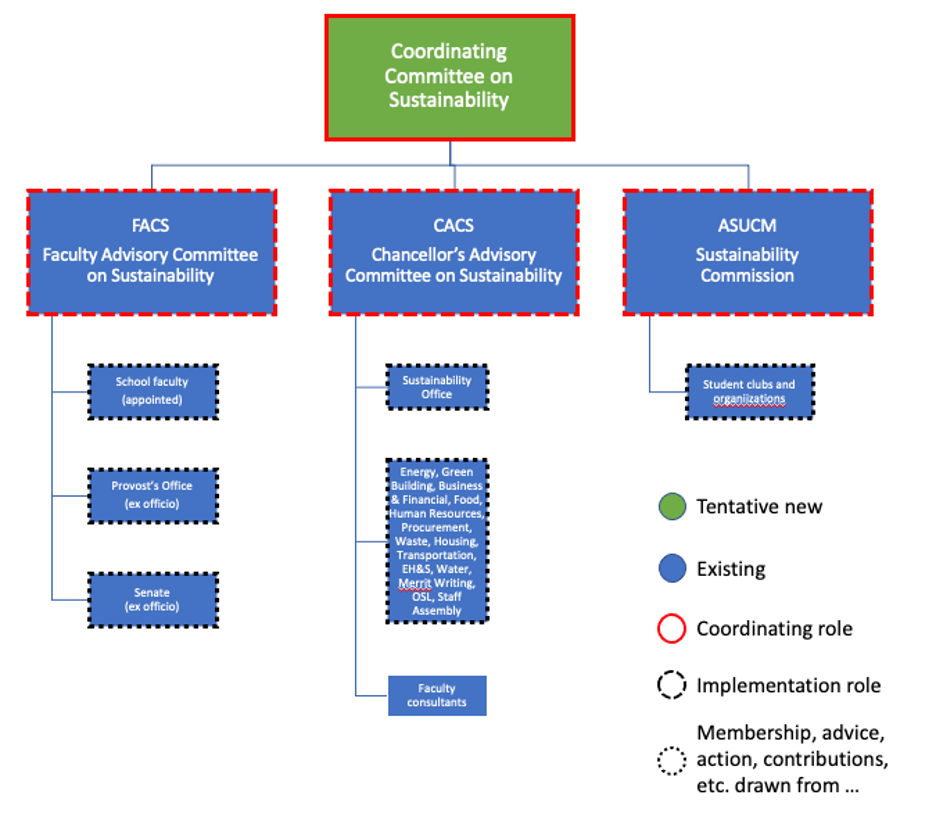
Organizational structure and composition of the Faculty Advisory Committee on Sustainability (FACS; blue) and its relationship to parallel administrative and student committees, which together are complemented by an informal group of three committee chairs (green, operating ad hoc for 2019-2022) coordinating and elevating sustainability efforts campus-wide.
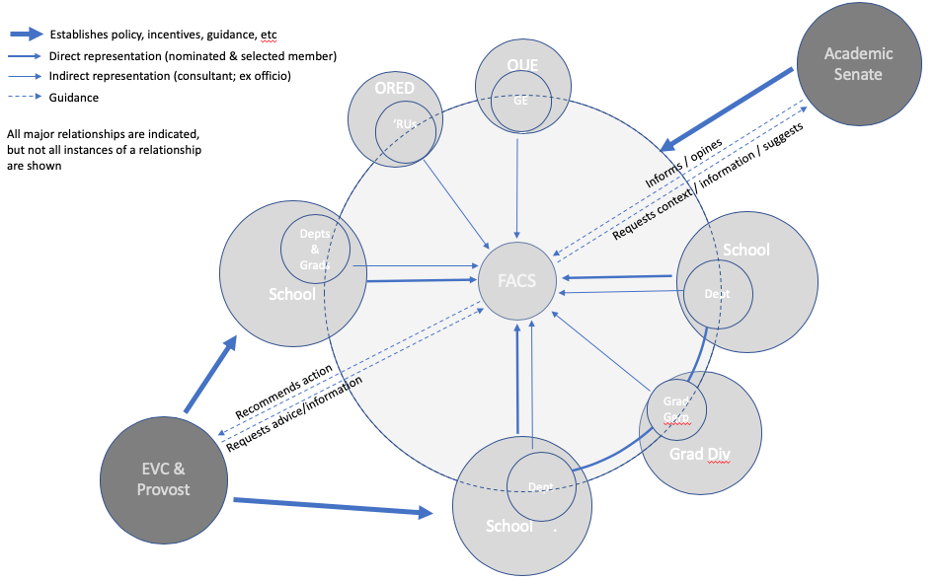

Operational relationship of the Faculty Advisory Committee on Sustainability (FACS) to academic and senate units across campus. FACS should act as a body that aims to receive input from all constituents and to support and enrich efforts across campus. The basic workflow may be conceived as priority-setting through iterative communication between the EVC & Provost and the FACS in consultation with the Academic Senate; perspectives and advice on any issues are solicited from the faculty via a network of direct and indirect representation through nominated school members and open communication with chairs/directors of departments, general education, graduate groups, research units, and undergraduate majors that have substantive activity in sustainability education and/or research. The largest grey circle is the Division. Note that, to avoid overcomplicating the image, only a subset of formal relationships among extant bodies are represented.