
Living Lab
Advancing climate action by transforming the entire campus environment into a collaborative living laboratory for students, faculty, and staff.

Program Overview
UC Merced’s Living Laboratory Pilot Program offers a unique opportunity for students and UC Merced staff to boost campus efforts in achieving climate action goals. Partners are tasked with producing potential research, programming, and/or implementation of decarbonization projects within UC Merced’s Campus. The Living Lab provides real-world education and experience while advancing UC Merced’s rapidly growing sustainability efforts.
All ten campuses in the UC Consortium have Living Labs, 3 campuses are piloting new Living Lab projects, and UC Merced is one of them. Living Labs are defined as utilizing the campus itself as an educational environment to learn. Living Labs have produced projects directly with students and/or faculty. These projects will improve practices of the campus community.
Strategic Objectives
-
Elevate Experiential Learning - Provide hands-on opportunities that prepare students to lead in their careers and give them knowledge of the Sustainability field
-
Support Faculty Research & Innovation - Utilize campus infrastructure, systems, and data as a platform for interdisciplinary research while collaborating with industry-leading faculty researchers
-
Strengthen Campus Partnerships - Foster collaboration between academic programs and operational units.
-
Advance Climate & Carbon Goals - Support implementation of UC Merced’s climate commitments from the Climate Action Plan through applied, data-driven solutions
-
Measurement & Reporting - All Living Lab (applied learning) projects focus on challenges related to climate change. Projects are required to measure impact related to greenhouse gas emissions, energy use intensity, zero waste measures, and diversion.
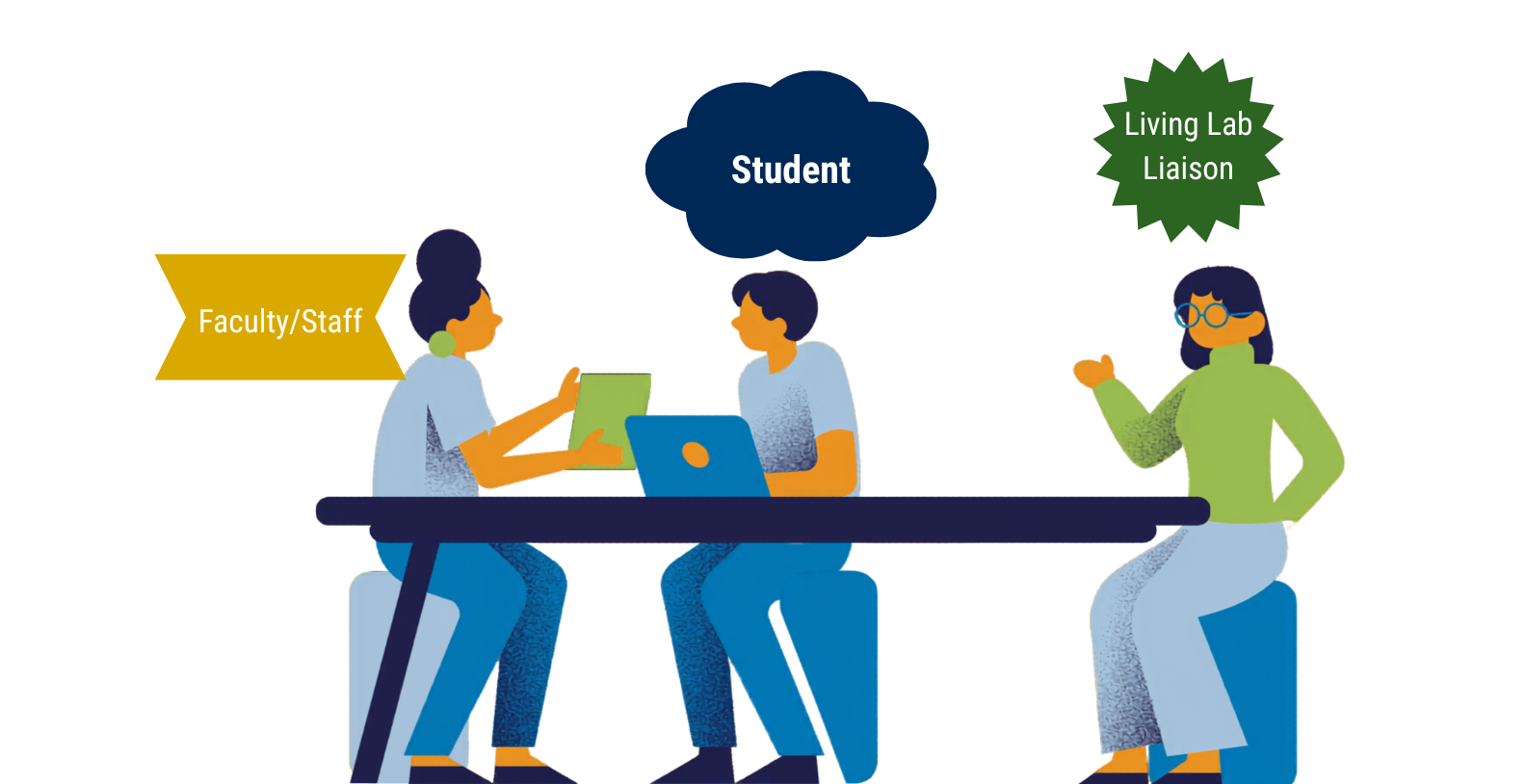
- Living Lab Liaison: Sawani Goonatilleke, Will be facilitating and project managing between stakeholder groups from start to finish.
- Student: Student who has proposed a Living Lab project and participated in the Living Lab coursework.
- Staff/Faculty: Any UC Merced Faculty/Staff who agrees to participate and facilitate proposed project.
- Partner Agency (optional): If projects do require an external partner to complete the project, we can support this.
Priority Focus Areas
- Energy & Utilities
- Water Management
- Waste Reduction & Circular Economy
- Sustainable Transportation
- Climate Action & Decarbonization
- Landscape & Biodiversity
- Equity & Community Engagement
Example Applications
- Solar-Powered Golf Cart Pilot
- Battery Workforce Challenge
- A Virtual Currency Framework for Equitable and Efficient Public EV Charging Access
- Bee Campus and Beyond: Promoting Pollinators through education and Action
- Distributed Water and Fertilizer Delivery for Minimizing Nitrogen Losses by Leaching and Volatilization
- Investigating the impacts of dust particle sizes from fallowed agricultural lands on public health and regional climate in San Joaquin Valley
Institutional Value of the Living Lab
- Enhancing student success through applied, career-relevant experiences
- Expanding interdisciplinary research and external funding opportunities
- Serves as a source of experiential learning to complement coursework
- Contributing to UC Merced’s Social Mobility Ranking by encouraging student leadership within the Central Valley
- Serves as a catalyst for student enrollment and faculty retention
- Improving operational efficiency and reducing environmental impact
Inaugural Projects
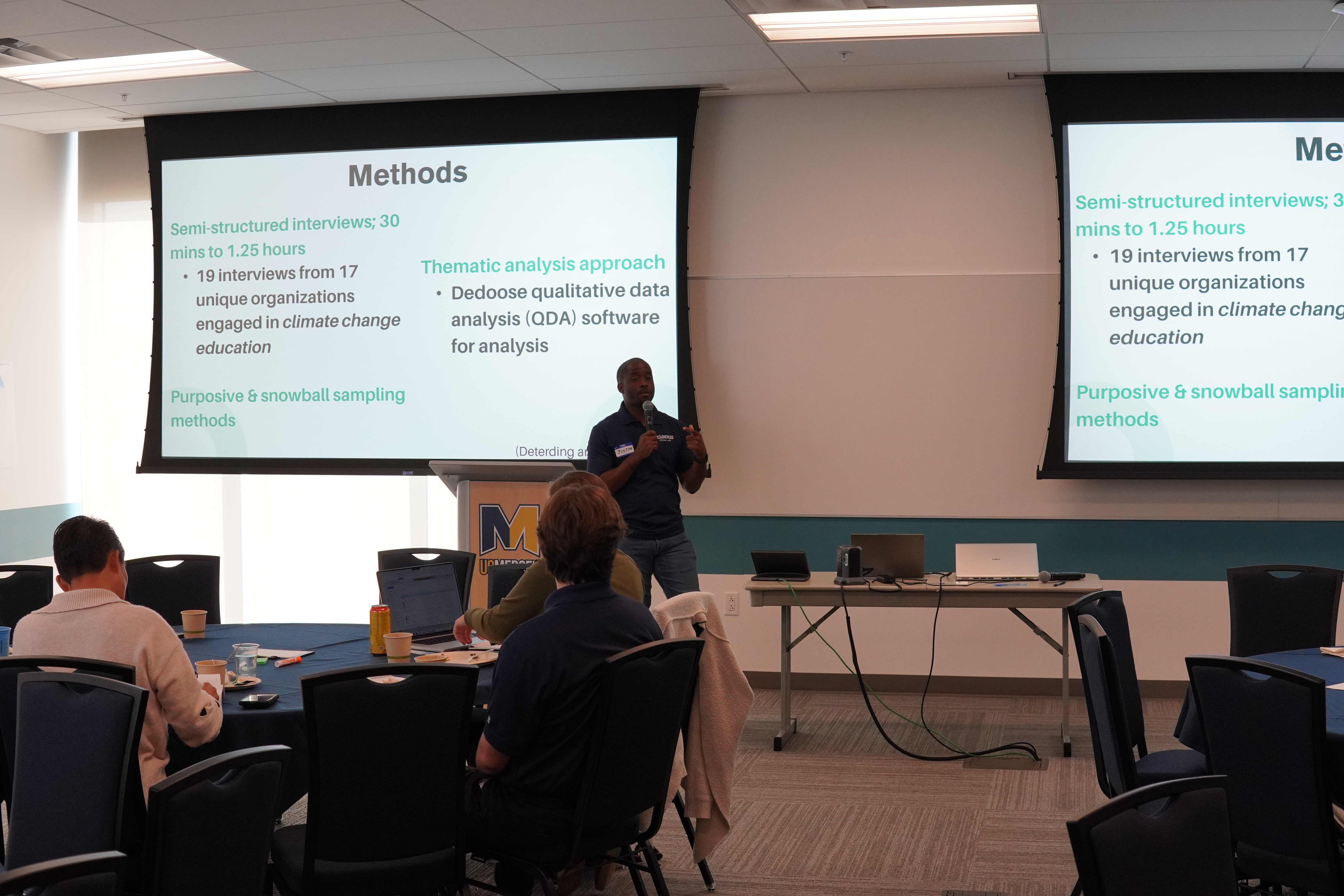
1. Climate Literacy Study
Team Members
Faculty: Dr. Paul Almeida
Student: Justin Barnes, PhD Candidate
Project: Working with the Sustainability Office and Living Lab, Justin Barnes helped to synthesize key findings regarding campus priorities from a recent campus-wide survey on sustainable, equitable practices. Justin helped to organize and visualize information from this survey to be included on the campus' central Climate Action Plan. Additionally, Justin shared his research with the campus community at the Climate Action Town Hall and helped to facilitate discussions around barriers and opportunities to climate action. This event provided an opportunity to extend the reach of his research and to gather new perspectives that supplement his findings. Justin conducted semi-structured interviews with participants from a variety of US organizations engaged in climate engagement, discussing key challenges when organizations frame climate issues with audiences. Presenting his findings, he focused on 2 key challenges when framing climate issues: 1) Difficulties with clearly communicating the problem and 2) Challenges with managing emotional barriers. To overcome these challenges and move people to engage with climate issues, climate advocates work to personalize and localize how they discuss climate change, often through storytelling, community-building, and civic participation opportunities.
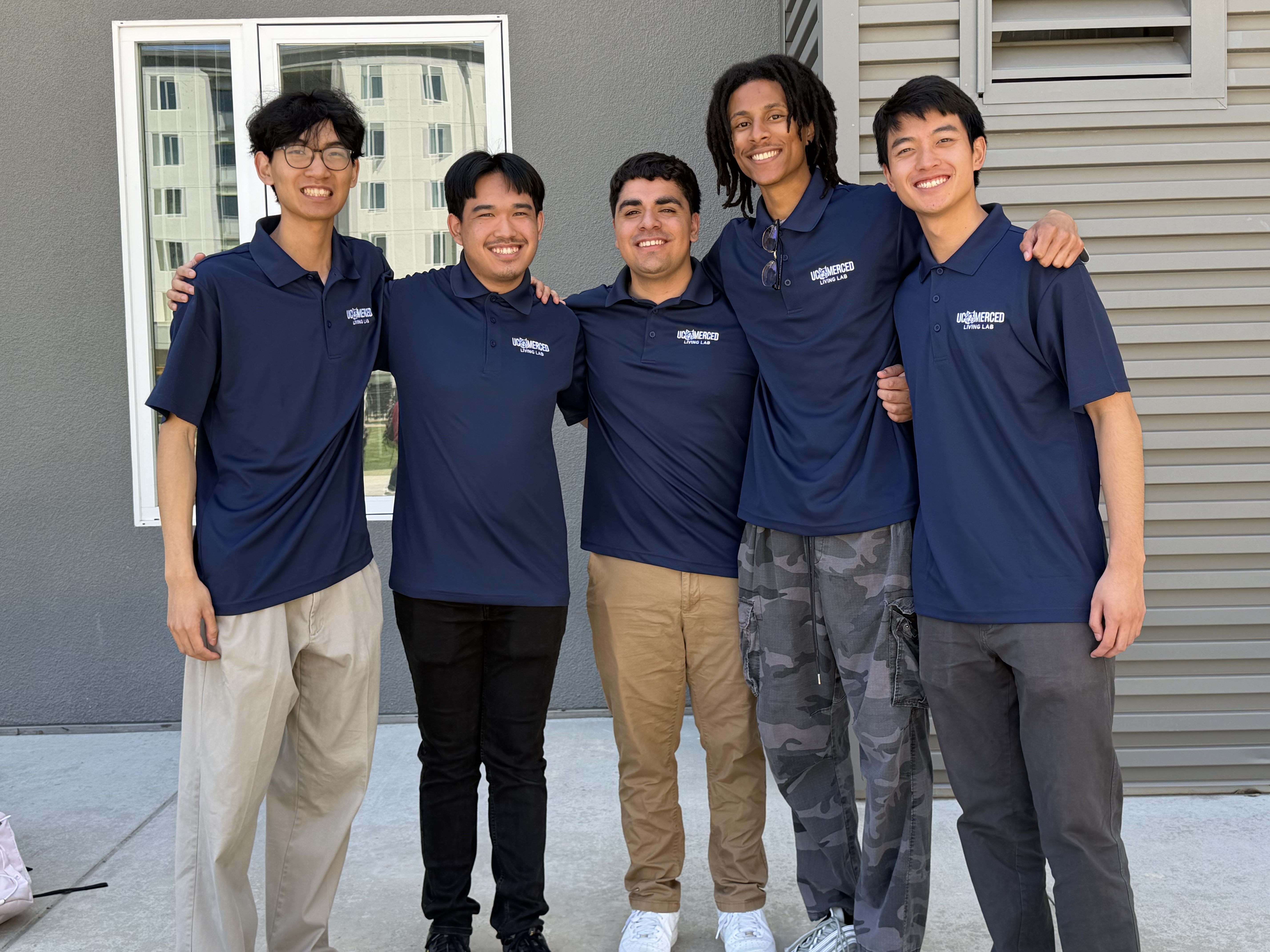
2. Sustainalytics Dashboard with I2G
Team Members
Faculty: Dr. Santosh Chandrasekar and Stefano Foresti
Students: Brian Huynh, Isaac Jee, Javon Hudgins, Julian Olaviano, Steven Murillo
Project: A student-led capstone project focused on designing and implementing a campus sustainability dashboard to track, visualize, and communicate key performance metrics. This dashboard will contain many working parts, including: utility tracking, GHG emissions, buildings, reporting, climate justice, and an ArcGIS interactive map. Find the project here!
3. Zero-Waste for Water
Partner (Staff): Allajah Wheatley, Zero-Waste Coordinator
Project: 1 Water Monster contains 125 gallons of water, diverting the use of 1,000 plastic water bottles. Water Monsters are a great way to eliminate plastic waste from campus events. Our trial at the 2026 Commencement ceremonies was a great success, and we are excited to bring this to all other campus events. Such as Bobcat Day, Move-In, Earth Day, etc. A student team of 4 students is ready to deploy water monsters to events as needed, and we are receiving requests from other campus departments to have our water monsters at their events.
4. Bobcat Swap and Shop
Team Members
Faculty: Professor Bristin Jones, School of Social Sciences, Humanities & Arts
Project: Bobcat Swap & Shop is a campus-wide circular economy program designed to reduce waste, promote reuse, and strengthen community well-being at UC Merced. The project establishes recurring swap events and a permanent donation-and-reuse system where students, staff, and faculty can exchange clothing. By diverting materials from landfill and extending product lifecycles, the initiative directly supports UC Merced’s climate action goals and fosters a culture of sustainability and shared responsibility.
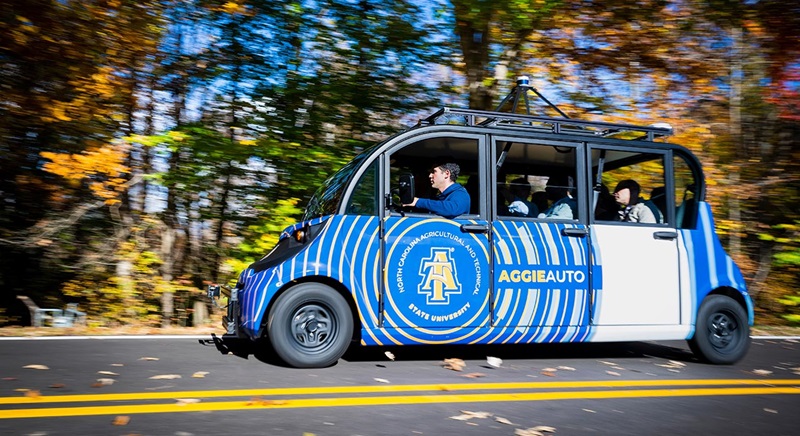
5. Autonomous EVs on Campus
Team Members
Faculty: Professor Ross Greer, School of Engineering
Project: Campus accessibility, heat, growing micromobility incidents, and pedestrian congestion at UC Merced create an urgent need for safe, low-emission intra-campus transit. This project develops and deploys an autonomous electric campus circulator along defined high-traffic routes to reduce congestion, relieve pressure on micromobility infrastructure, and provide an alternative transit option, while serving as a persistent testbed for student research in perception, planning, and control. A live public dashboard provides real-time vehicle location and drop-off availability, extending the platform as a visible demonstration of campus innovation.
6. Smart Solar Study Stations
Team Members
Faculty: Professor and Department Chair Sarah Kurtz, School of Engineering
Students: Rayan Dua, Samir Ahmed, Veronique Vorhis, Keval Doddapaneni
Project: S4 (Smart Solar Study Station) is a project focused on improving outdoor study spaces at UC Merced by upgrading existing shade structures with solar-powered features. The goal is to provide students with access to phone and laptop charging, lighting for evening use, and a more comfortable place to study, all while using clean, renewable energy. Rather than building new structures, the project explores retrofitting the ones already on campus, making it a more practical and cost-effective solution. The project will begin with a proof of concept using commercially available components and later transition to a custom-designed system that can be expanded across campus.
7. Soil to Table
Team Members
Partner (Staff): Mitch Vanagten, Executive Chef – Culinary Engagement & Strategic Partnerships
Project: Soil to Table: Climate, Community, and the Future of Food in the Central Valley is a collaborative educational initiative that explores the connection between climate action, sustainable agriculture, local food systems, and institutional dining. The project will bring together local farmers, a farm-to-table culinary advocate, students, faculty, staff, and community partners to examine how food choices and agricultural practices can contribute to a more sustainable future. Activities may include a documentary film screening, panel discussion, culinary demonstration, and tasting featuring locally sourced ingredients. Developed in partnership with UC Merced Dining and the Sustainability team, the project aims to engage students in meaningful conversations about the future of food while highlighting the unique agricultural landscape of California's Central Valley.
Contact & Next Steps
Want to learn more, propose a project, or get involved?
Our Website
Contact the Office of Sustainability!
or Complete our Project Proposal Form
Assistant Director of Sustainability/Living Lab Liaison: Sawani Goonatilleke
Location: SRE 108, (209)504-9296, sawanigoonatilleke@ucmerced.edu


