
Faculty Highlights
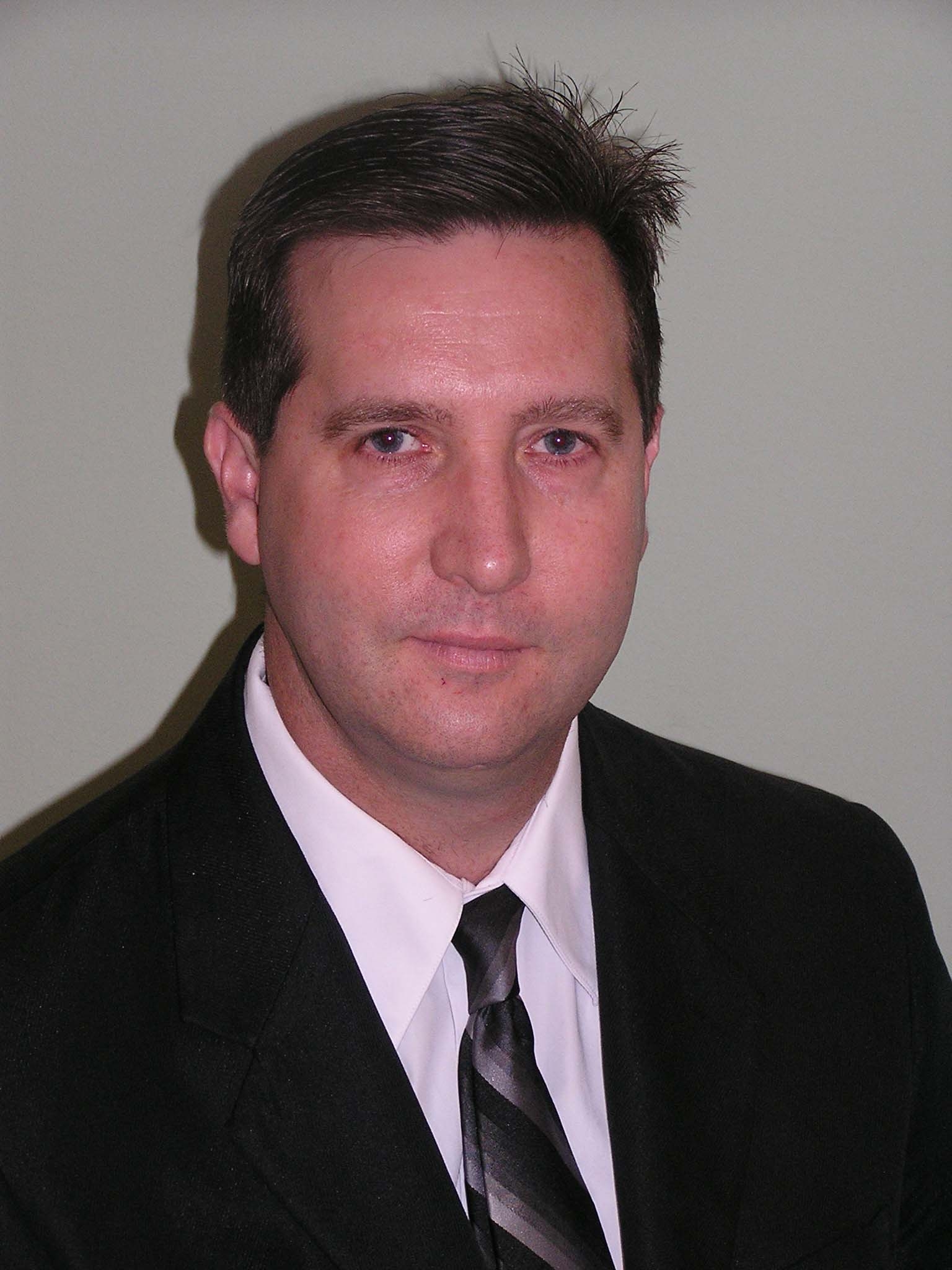
Paul Almeida, PhD
School: Social Sciences, Humanities, and Arts
Department: Sociology (Dr. Almeida's Sociology Website)
Paul Almeida is a Professor of Sociology and Environmental Systems at the University of California, Merced. Almeida’s research centers on the efficacy of collective action at the local, national and global levels of social and political life. He has empirically examined the timing, distribution, and outcomes of dozens of large-scale campaigns whereby ordinary people and excluded social groups mobilized to protect themselves from the loss of vital necessities such as environmental quality, health care, pensions, water services/utilities, and other socio-economic rights. His recent work focuses on locally-based challenges and responses to climate change. Since 2020, he has implemented representative surveys with partner groups in towns and cities throughout the San Joaquin Valley on community needs and/or climate action.
Almeida is a founding member of the UC Merced Community and Labor Center. He sits on the Steering Committee of the University of California Institute on Global Conflict and Cooperation (IGCC). He also serves as the Liaison at UC Merced for the Fulbright Scholar Program. He is an affiliate of Brown University's Climate Social Science Network (CSSN) and co-directs the Valley Plan on Climate Investments, Jobs, and Technologies. Almeida is the Chair-Elect of the Collective Behavior and Social Movements (CBSM) section of the American Sociological Association (ASA) and the Past Chair of the Political Sociology section of the ASA. His articles have appeared in the American Behavioral Scientist, American Journal of Sociology, Annual Review of Sociology, Environmental Justice, Mobilization, npj Climate Action, Social Forces, Social Movement Studies, Social Problems, and other scholarly outlets.
Teaching: Environmental sociology (established 2012).
Sustainability Related Publications:
Almeida, Paul D. 2026. Climate Change and Civic Engagement: The Origins and Future of the Climate Justice Movement. Berkeley: University of California Press.
Almeida, Paul D. 2026. “Climate Change and Climate Justice Movements.” in The Wiley-Blackwell Encyclopedia of Social and Political Movements, eds, David A. Snow, Donatella della Porta, and Doug McAdam. Oxford: Wiley-Blackwell. 2nd Ed.
Almeida, Paul. 2020. “USA-Country Report.” Pp. 247-253 in Joost de Moor, Katrin Uba, Mattias Wahlström, Magnus Wennerhag and Michiel De Vydt (Eds.). Protest for a future II: Composition, mobilization and motives of the participants in Fridays For Future climate protests. Stockholm: Swedish Research Council for Sustainable Development.
de Moor, Joost, Katrin Uba, Mattias Wahlstrom, Magnus Wennerhag, Michiel De Vydt, Paul Almeida, Beth Gharrity Gardner, Piotr Kocyba, Michael Neuber, Ruxandra Gubernat, Marta Koczynska, Henry P Rammelt, and Stephen Davies. 2020. “Introduction: Fridays For Future - an expanding climate movement.” Pp. 6-33 in Joost de Moor, Katrin Uba, Mattias Wahlström, Magnus Wennerhag and Michiel De Vydt (Eds.). Protest for a future II: Composition, mobilization and motives of the participants in Fridays For Future climate protests on 20-27 September, 2019, in 19 cities around the world. Stockholm: Swedish Research Council for Sustainable Development.
Almeida, Paul D. 2019. “Climate justice and sustained transnational mobilization.” Globalizations 16(7): 973-979.
Almeida, Paul D. 2019. Social Movements: The Structure of Collective Mobilization. Berkeley: University of California Press.
Almeida, Paul D. 2018. “The Role of Threat in Collective Action.” Pp. 43-62 in D. Snow, S. Soule, H. Kriesi, and H. McCammon, eds., Wiley- Blackwell Companion to Social Movements. Oxford: Wiley-Blackwell.
Stearns, Linda Brewster and Paul D. Almeida. 2004. "The Formation of State Actor-Social Movement Coalitions and Favorable Policy Outcomes.” Social Problems 51(4): 478-504
Almeida, Paul D. and Linda Brewster Stearns. 1998. “Political Opportunities and Local Grassroots Environmental Movements.” Social Problems 45(1): 37-60.
Almeida, Paul D. 1998. "The Network for Environmental and Economic Justice in the Southwest," Pp. 159-187 in D. Faber (ed.) The Struggle for Ecological Democracy: Environmental Justice Movements in the United States. New York: Guilford.

Colleen C. Naughton, PhD
"My passion for service, the environment, and helping address inequalities in the world was solidified when I was in Model United Nations in high school. Instead of international relations, I chose engineering to learn how to “solve problems” with encouragement from a high school counselor. I obtained my B.S. in Civil Engineering with an Environmental Concentration from Purdue University (GO BOILERS!!) in 2008. I then joined the Peace Corps Masters International Program at the University of South Florida where I combined my graduate education and research with service in the Peace Corps as a Water, Sanitation, and Hygiene Engineer in Mali, West Africa from 2009-2012. Upon completion of my PhD and post doc in 2017, I became an American Association for the Advancement of Science (AAAS) Science and Technology Policy fellow in Washington D.C. before joining the faculty in Civil and Environmental Engineering at UC Merced in January 2019."
School: Engineering
Department: Civil and Environmental Engineering
Professional Appointments: Member of Faculty Advisory Committee on Sustainability
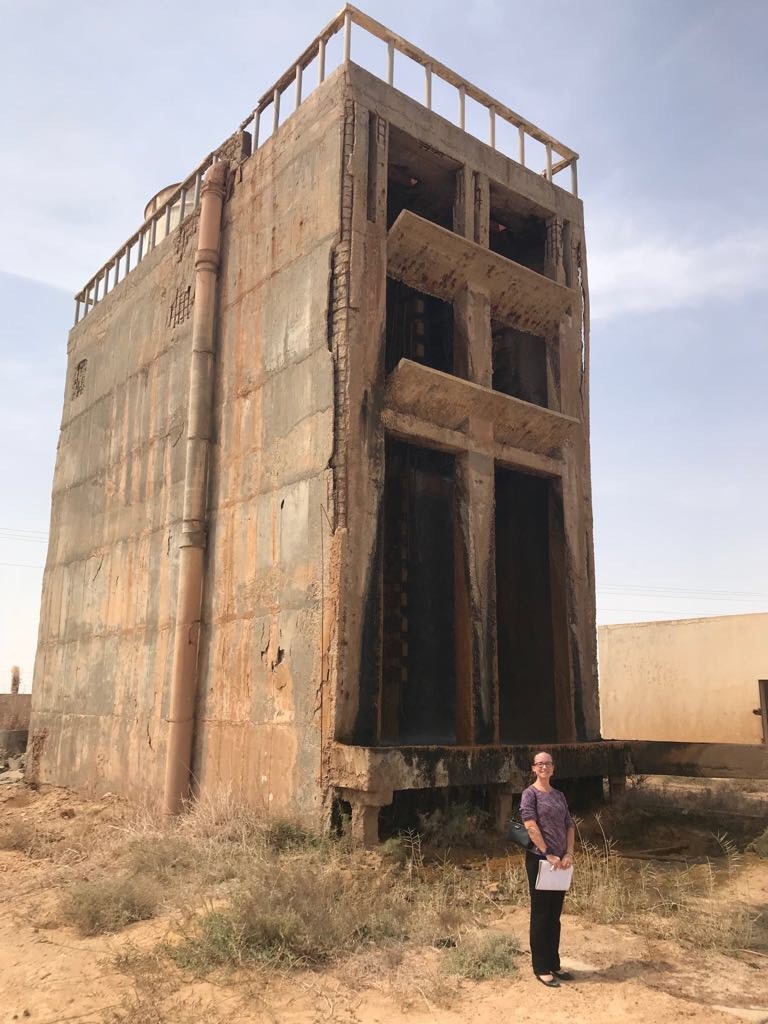
Dr. Naughton during her American Association for the Advancement of Science (AAAS) Science and Technology Policy Fellowship where she served as an Environmental and Social Systems specialist for the Millennium Challenge Corporation (A U.S. international development agency). Here she is on a mission to Tunisia, evaluating current infrastructure for a water project. In the background is a geothermal cooling tower for groundwater in need of rehabilitation to reduce water loses in a desert climate.
Research: " My research designs sustainable and culturally sensitive food-energy-water systems (FEWS) through Life Cycle Sustainability Assessment (LCSA), Geographic Information Systems, integration of anthropology and engineering, and effective science policy. Often we focus on one sector in FEWS and miss key tradeoffs or impacts in the other sector (e.g. moving to drip irrigation to save water but then increase energy requirements). LCSA is a method to quantify environmental, social, and economic impacts from cradle to grave or farm to plate to design sustainable systems. My research also focuses on improving access to clean water to all through mapping contamination and designing sustainable water treatment methods. A graduate student in my lab is looking at 1,2,3-trichloropropane contamination from soil fumigants and treatment through Granulated Activated Carbon of almond shells. Overall, I strive to follow a Community Based Participatory Research approach where I solicit research needs from the community and communicate results continuously. "
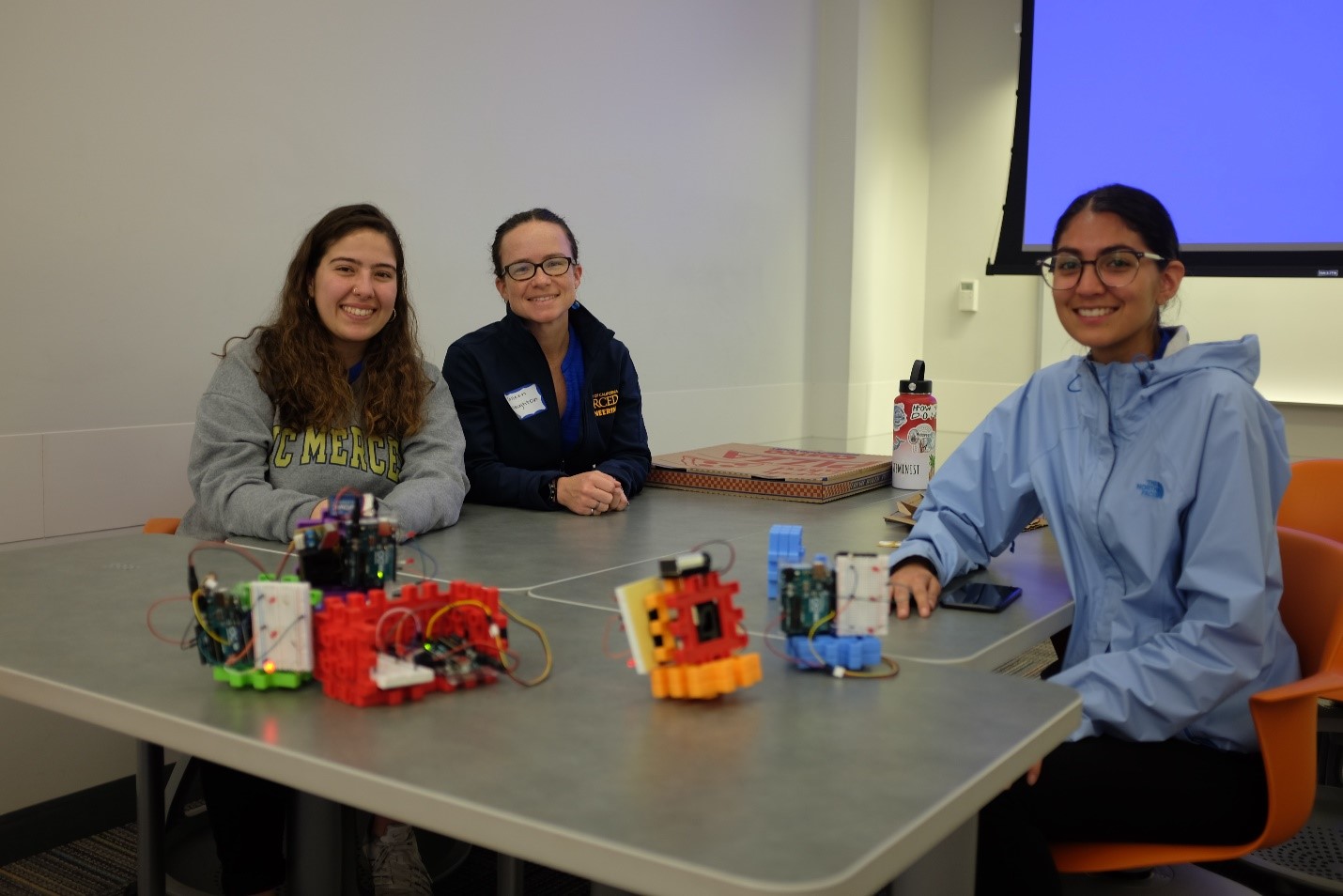
Dr. Naughton and two undergradutate researchers in her lab after the UC Merced Society of Women Engineer's Expanding Your Horizons event for over 200 middle and high school girls. Our activity involved learning about air pollution and building EPA low-cost particulate matter sensors
Courses & Learning Outcomes: ENVE 020- Introduction to Environmental Science and Technology, Coming soon, upper level course on Sustainable Development Engineering for Communities. Key student learning outcomes for ENVE020 related to sustainability: (1) Explain local and global environmental problems and their impact on human health, welfare, natural systems, and natural resources and the needs of society, (2) An ability to apply engineering design to produce solutions that meet specified needs with consideration of public health, safety, and welfare, as well as global, cultural, social, environmental, and economic factors, (3) An ability to recognize ethical and professional responsibilities in engineering situations and make informed judgements, which must consider the impact of engineering solutions in global, economic, environmental, and societal contexts.”
How did you get engaged with sustainability?
" I think I first became engaged with sustainability through my grandmother who was an avid recycler then when I took a trip out west (I’m from Michigan) with my family when I was eight and saw Yellowstone national park and many natural wonders along the way. Then in high school Model United Nations, I learned more about the environmental destruction across the globe and importance of protecting our environment to ensure peace, food security and clean water for all. From there, I have emphasized in sustainability throughout my education, service, research, and daily practices as much as possible. UC Merced’s emphasis in sustainability and (Leadership in Energy and Environmental Design) LEED certified buildings are what drew me to my current position here. "
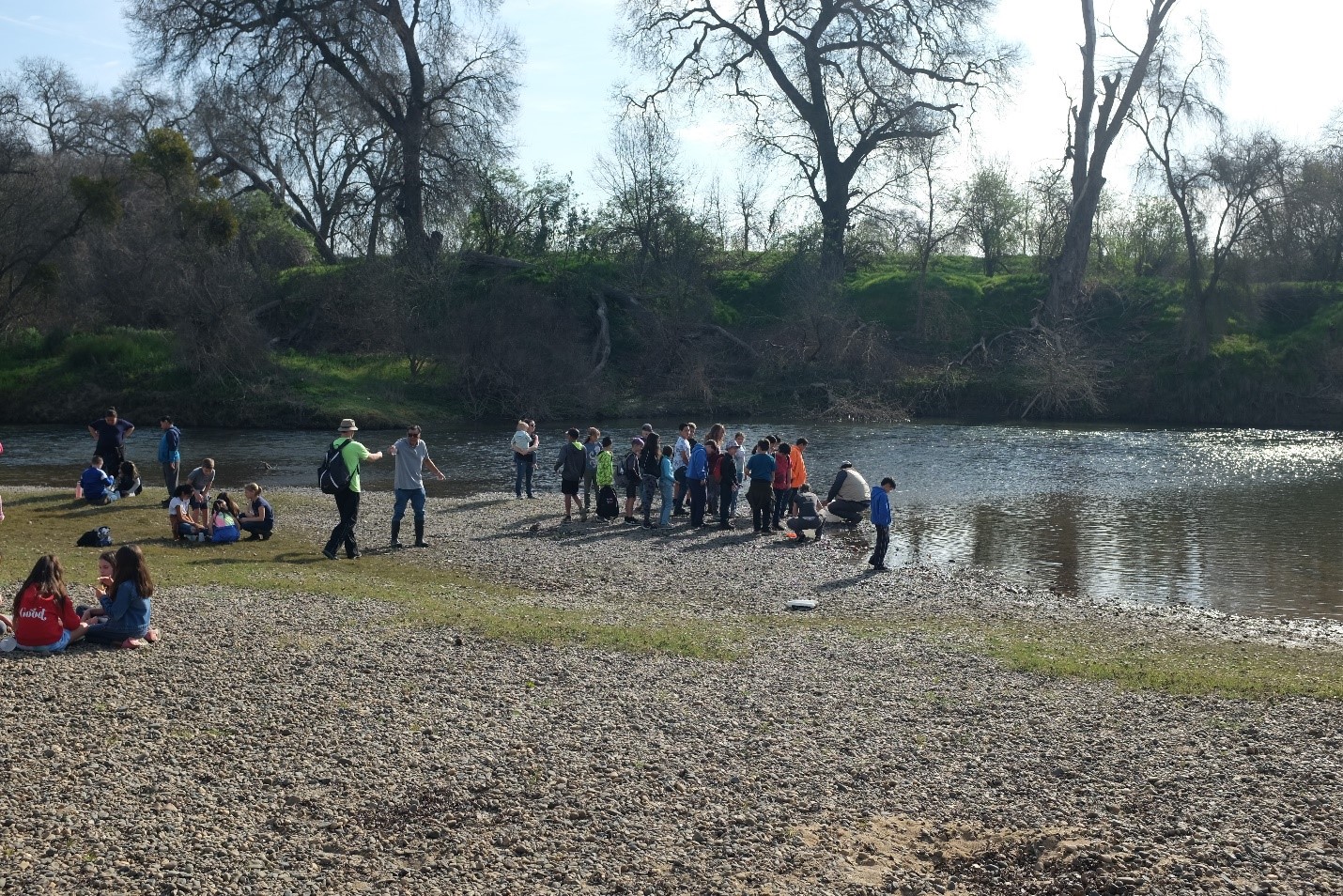
Releasing Salmon in March 2020 in collaboration with the East Merced Resource Conservation District and 125 elementary students from Ballico elementary (8 undergraduate and graduate student volunteers from UC Merced participated)
How is your teaching and/or research making a difference?
"The world’s problems and inequalities can be overwhelming, and can make us wonder if we really can make a difference of if we should try at all. I try through my daily interactions with others, service, research, and teaching to make a difference even in small ways. Through my Life Cycle Sustainability Assessment research, I quantify the environmental, economic, and social impacts of products or processes particularly in agriculture to design sustainable improvements and help consumers make informed choices. I have done this for shea butter production but now my group is focusing on different crops in California (fresh tomatoes, figs, etc.). I also try to increase access to clean water by mapping contamination and health impacts, designing sustainable water treatment systems, and community outreach. I interweave sustainability through my Introduction to Environmental Science and Technology lessons and my students have group projects in sustainable design."
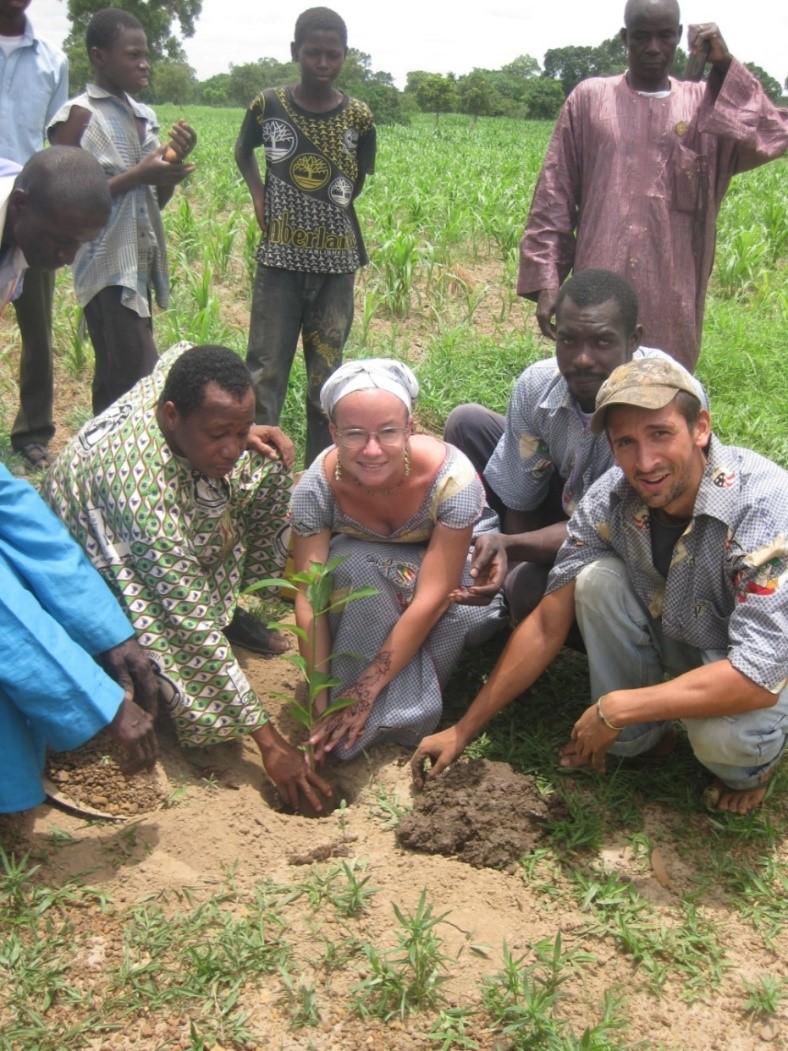
Planting a Baobab tree during her going away ceremony upon completing my service as a Peace Corp’s Water and Sanitation Engineer in Mali, West Africa
Research grants in the past 5 years: Key personnel, USF $2.5 million NSF NRT-INFEWS: Systems Training for Research ON Geography-based Coastal Food Energy Water Systems (STRONG-CFEWS), 9/1/2017-8/30/2022
Sarah Kurtz, PhD
“The beautiful thing about renewable energy is that the more you use it, the cheaper it gets, which paves a pathway to prosperity for the whole world.”
After more than 30 years at the National Renewable Energy Laboratory, I am very pleased to join the faculty of the University of California Merced. I am excited to support UC Merced in educating the next generation of leaders and to do the research needed to accomplish the clean energy transition at an even lower cost than what we pay today for electricity.
School: Engineering
Department: Materials Science and Engineering
Professional Appointments:
Chair of Materials and Biomaterials Science and Engineering Graduate Program
Member of National Academy of Engineering
Testbed 3 lead for QESST
Advisory Board member for a number of organizations
Research: "I started research on amorphous silicon solar cells in 1980 and feel very privileged to be a small part of the success of solar in the last 30 years! I worked on multi-junction III-V solar cells, helping Jerry Olson at the National Renewable Energy Lab (NREL) to launch his invention of the GaInP/GaAs solar cell. At the time it was patented, that invention was assumed to be worthless, so NREL didn’t retain title and later had to ask the Department of Energy to give the title back. Now the grandchildren of those solar cells power most satellites and even powered some of the Mars rovers. In an effort to help those solar cells also be used to generate electricity on earth, I spent about ten years working on the reliability of solar modules and systems.
When I moved to UC Merced late in 2017, I wanted to support California’s transition to zero-carbon energy, but it wasn’t clear what would be the best approach. I was hesitant to join the growing effort on modeling of tomorrow’s energy system because I don’t trust the models. These models use something like a million inputs and create about a million outputs and how would one ever know if the results are meaningful (garbage in will give garbage out and who really knows what a battery will cost in 10 or 25 years?) But, after substantial reflection I decided that a modeler who is skeptical of models might be able to make a contribution, so I wrote a proposal and won over a million dollars to model long-duration storage. I am currently leading a team including UC Merced, UC Berkeley, UC San Diego, the University of North Carolina Chapel Hill, and the University of Texas Austin to study the value of long-duration storage toward meeting California’s goals to decarbonize the grid.
I also have the hardware to measure outdoor performance of solar panels and am hoping to be able to study performance of tandem solar panels (tandem solar panels use two different materials, one to convert visible light and another to convert infrared light to electricity).
Solar energy is becoming more prevalent and there are many opportunities to join research efforts – my group has wide ranging conversations about all aspects of the energy transition."
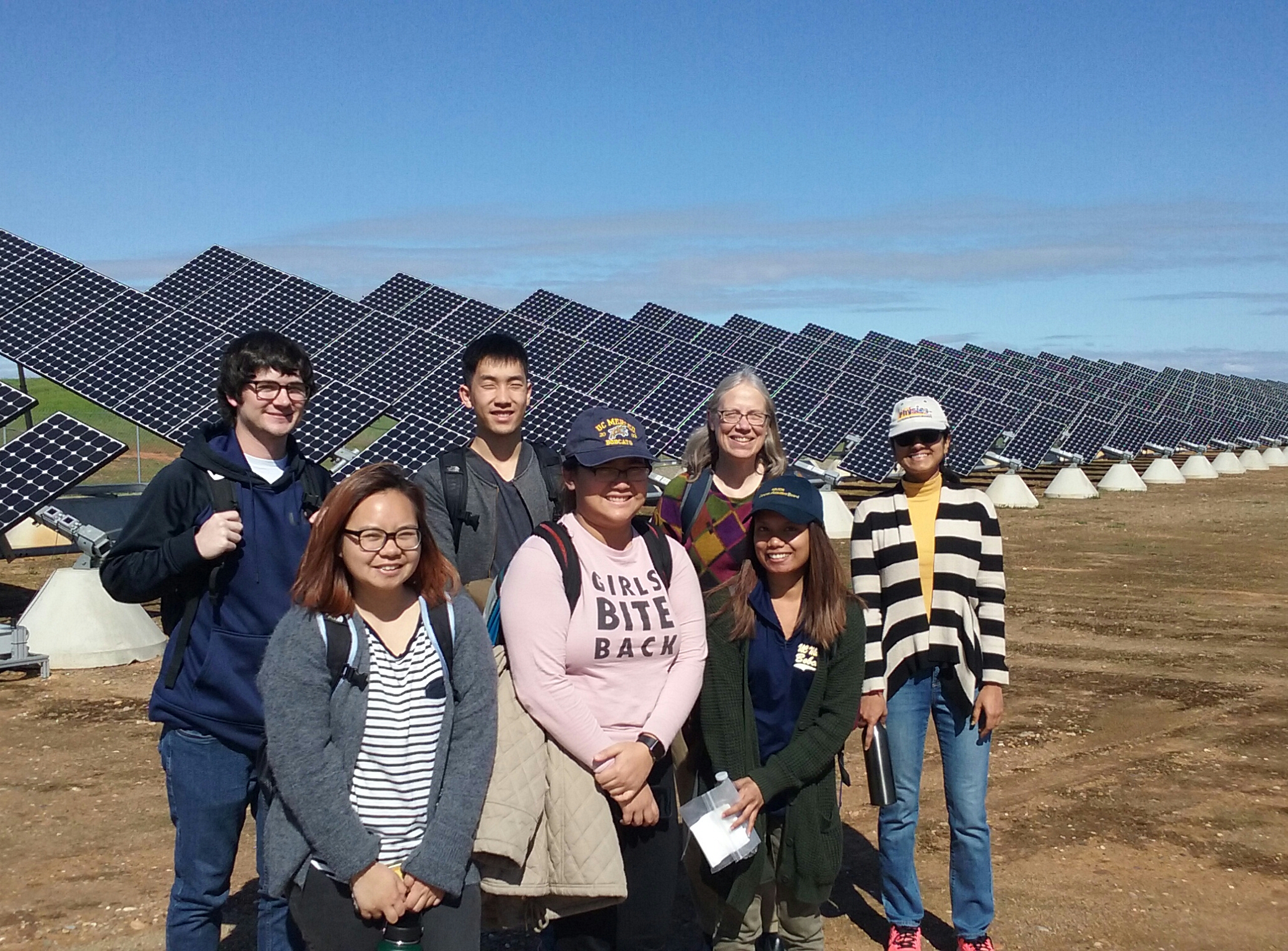
UC Merced students learn about solar energy and the effects of dust on solar panel output in Merced
Courses & Learning Outcomes:
"MSE 010: Intrigue of Everyday Materials in a High-tech World: (Undergraduate) Fall 2021
This new course will be a 2-unit course designed to introduce students to Materials Science teaching the fundamental concepts of Materials Science as well as experimental design, data collection and data analysis while targeting fun projects. Does an M&M really melt faster in your mouth than in your hand? What materials property do you need to understand to be able to poke a needle through a balloon without popping it?
ES 260: Sustainable Energy: (Graduate) Spring 2022
This course is being separated from the undergraduate version starting in 2022. It will include all aspects of the energy system with special focus on renewable electricity technologies and the supporting technologies that are needed to make renewable energy successful. Three key elements of tomorrow’s energy system will include: 1) renewable electricity (think wind and solar), 2) electrification (which can improve efficiency to reduce energy needs by a factor of three!), and 3) a flexible grid (which includes not only storage, but demand management and load shifting using many strategies and new technology).
MBSE 299: Solar Cells, Modules & Systems: (Graduate) Fall 2022
This course was taught once before and will be taught next in Fall 2022. It expects graduate students to understand how solar cells work and also how these are implemented in solar panels and then connected to the grid as a major power source. In 2020, 22% of the electricity generated in California came from solar panels – the students of this course should know where to find and track such data."
How did you get engaged with sustainability?
"In 1980 when I was selecting a research professor for my graduate work, Prof. Roy Gordon was starting an effort to make inexpensive solar cells. It sounded like a great opportunity. After I finished my graduate work, I got a post doc at the Solar Energy Research Institute, which is now the National Renewable Energy Laboratory. After a year as a post doc, I was hired as a scientist and worked there on solar energy for more than 30 years.”
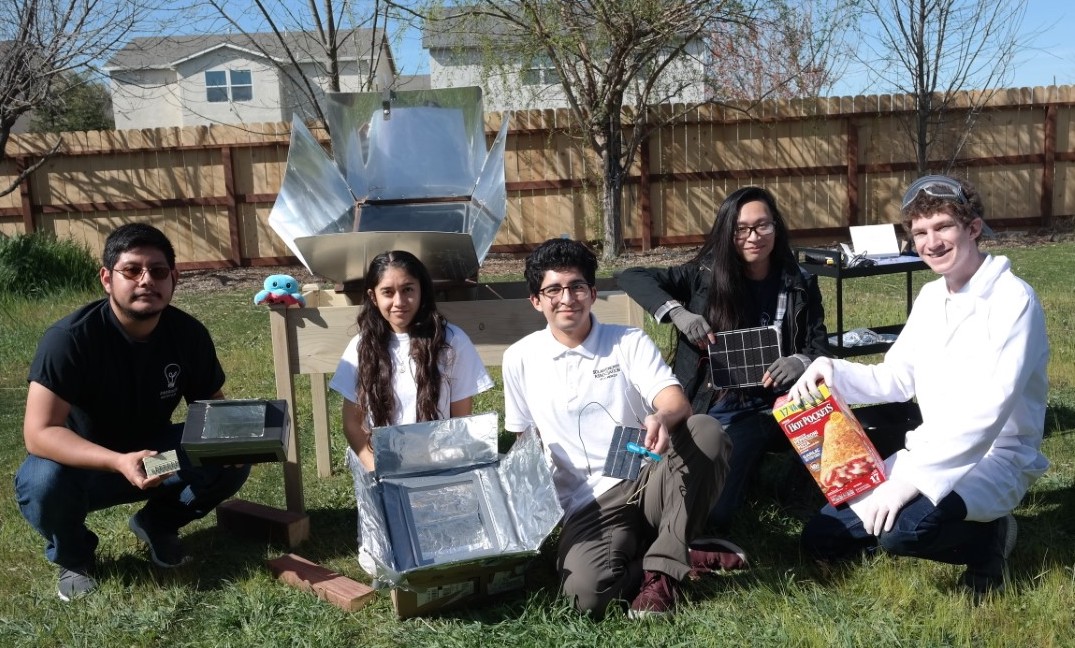
Students in UC Merced’s Solar Energy Association learn about solar ovens.
How is your teaching and/or research making a difference?
“Our research is looking for how to execute the energy transition and lower costs at the same time. For example, as we start using electric vehicles (EV) will we charge them directly from solar energy or will we charge them from batteries that were charged by solar energy. I think UC Merced should cover all of the parking lots with solar panels and install charging stations so that anyone who parks at UC Merced can charge their EV while on campus. What if all of the shopping malls had solar panels over their parking lots and offered free charging of EVs between 10 am and 2 pm, would you spend longer shopping there and then be able to drive your EV without generating carbon dioxide?
Many of the students who I interact with look for jobs with the solar industry.
I’m really excited that Kaycee Chang, who started the Solar Energy Association at UC Merced, is now working at the California Energy Commission managing research project on solar energy and related things.”
Research grants in the past 4 years:
Modeling of Long Duration Storage for Decarbonization of California Energy System -- California Energy Commission ($1.25M)
Integration of solar into the cloverleafs and diamond intersections -- California Department of Transportation ($250k)
Identifying and reducing barriers to TW scale deployment of solar energy -- NSF funding through Arizona State University; QESST Testbed 3: (~$200k)
Outdoor performance of GaAs panels relative to silicon panels -- Alta Devices (~$70k)
How to detect soiling of irradiance sensors -- Envision Energy ($19k)
Abel Chuang, PhD
School: Engineering
Department: Mechanical and Aerospace Engineering
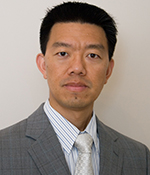
Abel Chuang is a Professor of Mechanical and Aerospace Engineering, Department Chair, and Graduate Program Chair at the University of California, Merced. Chuang's research centers on hydrogen and sustainable energy technologies, including fuel cells, electrolyzers, and related materials and diagnostics. His work with the Thermal and Electrochemical Energy Laboratory (TEEL) has produced 80+ publications since the early 2000s. Serving as the Faculty Director of the Sustainable Energy Center, his involvement in research and activities related to clean and sustainable energy is ongoing. The Sustainable Energy Center (or Energy Center) also operates as an affiliated research hub under the Sierra Nevada Research Institute (SNRI), along with the Earth Institute at UC Merced. It focuses on developing and improving advanced batteries, energy storage, hydrogen fuel cells, solar technologies, and system integration for a clean energy future.
Teaching: Thermodynamics
Sustainability Related Publications:
Clean/Green Hydrogen & Renewable Energy Systems
Tubalinal, Honesto Ovid S., Michael T. Castro, Myron T. Alcanzare, DJ Donn C. Matienzo, Julie Anne DR Paraggua, Po-Ya Abel Chuang, and Joey D. Ocon. "Prospects of green hydrogen production in the Philippines from solar photovoltaic and wind resources: A techno-economic analysis for the present and 2030." Renewable Energy 235 (2024): 121286. https://doi.org/10.1016/j.renene.2024.121286
Na, W., Gou, B., Kim, J., Mojica, F., Chuang, P.A., “Complementary cooperation dynamic characteristics analysis and modeling based on multiple-input multiple-output methodology combined with nonlinear control strategy for a polymer electrolyte membrane fuel cell,” Renewable Energy, 149 (2020): 273-286. https://doi.org/10.1016/j.renene.2019.12.059
Mojica, F. E., Chuang, P. A., Ruiz, U. “Solar Regenerative Hydrogen Fuel Cell Charging System,” Paper presented at 2017 ASEE Annual Conference & Exposition, Columbus, Ohio. https://peer.asee.org/solar-regenerative-hydrogen-fuel-cell-charging-system
Chen, Yanan, Felipe Mojica, Guangfu Li, and Po‐Ya Abel Chuang. "Experimental study and analytical modeling of an alkaline water electrolysis cell." International Journal of Energy Research 41, no. 14 (2017): 2365-2373. https://www.researchgate.net/profile/Po_Ya_Chuang/publication/318504207_...
Battery Recycling & Circular Economy
Zhu, Jiyong, Anahitha Asadi, Dongxin Kang, Joey Chung-Yen Jung, Po-Ya Abel Chuang, and Pang-Chieh Sui. "Bipolar membranes electrodialysis of lithium sulfate solutions from hydrometallurgical recycling of spent lithium-ion batteries." Separation and Purification Technology (2024): 128715. https://doi.org/10.1016/j.seppur.2024.128715
Environmental Impact & Cleaner Production
Zhang, H., Sarker, M., Rahman, M. A., Zhan, Z., Sui, P. C., Chuang, P. A., “Numerical investigation and experimental validation of water condensation in the gas diffusion layer with different properties,” Journal of Cleaner Production, 402, 136792 (2023) https://doi.org/10.1016/j.jclepro.2023.136792
Sustainable Agriculture & Built Environment
Naranjani, B., Najafianashrafi, Z., Pascual, C., Agulto, I., Chuang, P. A., "Computational Analysis of the Environment in an Indoor Vertical Farming System,” International Journal of Heat and Mass Transfer 186 (2022) 122460. https://doi.org/10.1016/j.ijheatmasstransfer.2021.122460
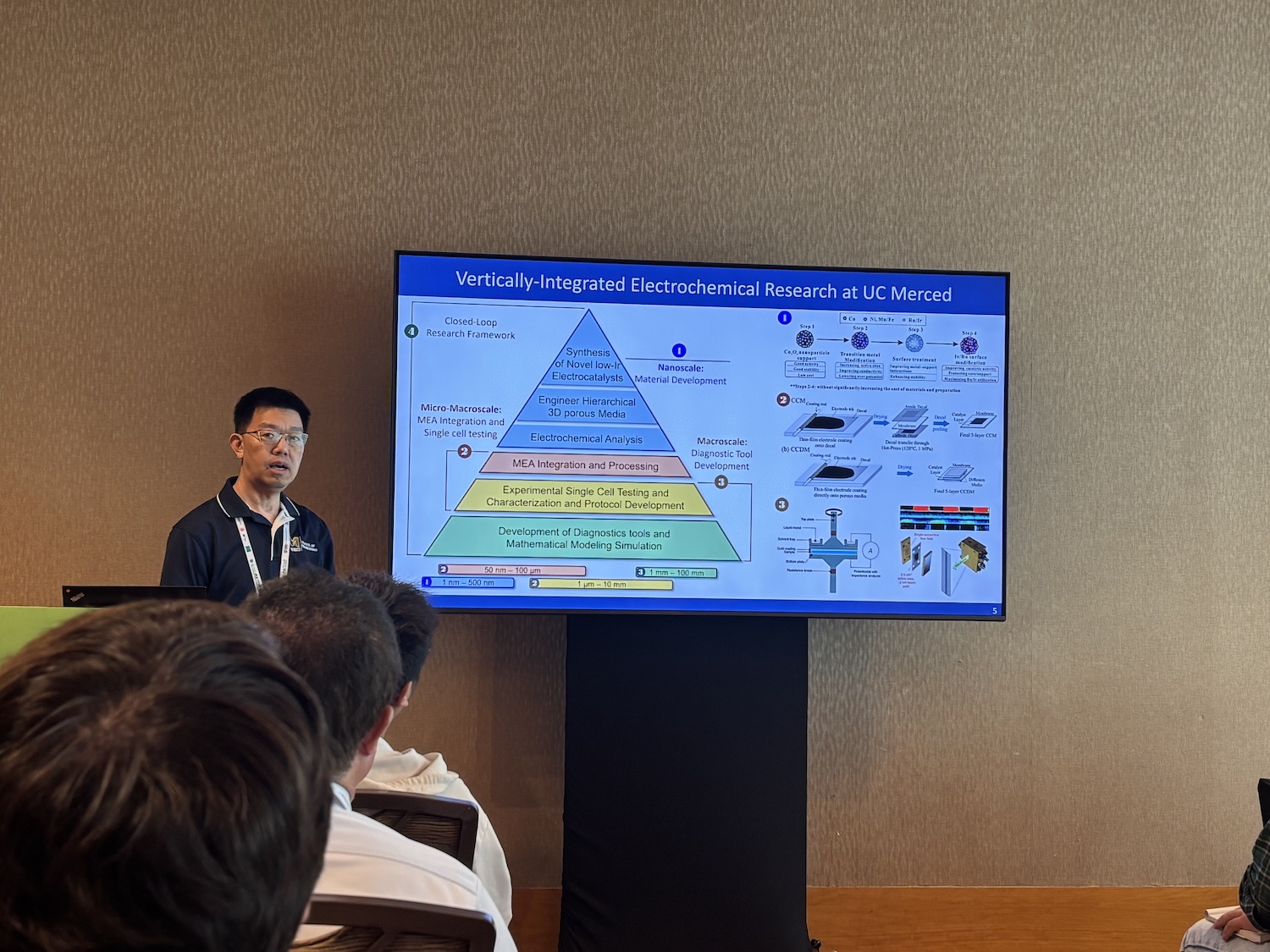
Dr. Chuang presenting electrochemical research from UC Merced at the World Hydrogen Energy Conference (WHEC) in Singapore (June 2026).
Eric Cheng
Bristin Jones
Tracey Osborne


